To spend your life living in fear, never exploring your dreams, is cruel.

Showing posts with label Other. Show all posts

Monday, December 3, 2012

Melbourne 2012 Runs


I've done a couple of runs in the last month or so. The first was the 21km Melbourne half marathon, part of the Melbourne running festival. The second was the 14km city-to-sea, which is the Melbourne version of the more famous city-to-surf run in Sydney. The half marathon started outside the MCG, headed South for a loop around Albert Park, and returned North again to finish inside the MCG. The city-to-sea started just South of Flinders Street station, taking a similar route, but headed West to the coast at St Kilda following the Albert Park loop. Both runs were fairly flat with no hills to speak of, and unusually for Melbourne, the weather was perfect.

Both days started with a taxi ride to the city, due to the complete lack of public transport early on a Sunday. I didn't train as well I should've, but went out fairly hard in the half marathon, basically just holding out until the end. I was still way off two hours, finishing in 2:05:55. I took the city-to-sea a bit easier, finishing the 14km run in 1:22:55. Unfortunately I haven't got around to doing much running since then, but I hope to get back to it following my not so well deserved vacation in Vietnam.

Thursday, August 5, 2010

A Weighty Issue


So I've registered for the Melbourne half marathon, more as an incentive to get back into running than for anything else. I'm pretty slow but have run three marathons (Thailand Temple Run, Bangkok, Edinburgh) and a few half marathons (Sydney, Melbourne, Singapore), though that was some time ago. I've got a couple of months to train so we'll have to see how it goes.

I'm fairly heavy now, at 82kg, and want to lose about 8kg for the run. Losing weight is a simple matter of mathematics. If you USE more calories (a unit of energy) than you CONSUME, you will lose weight, and you can even calculate how much.

USE: Even if you do absolutely nothing all day, you will use about 1 kcal per hour per kilogram of your weight. For me that's about 80 kcal per hour, or about 2000 kcal per day. For running or cycling I use an additional 700 kcal per hour, and for walking it is about 300 kcal. So I'll use about 2000-3500 kcal, depending on my level of activity, which I hope to keep at 3000 or more.

CONSUME: Calories are consumed either through fats (9 kcal per gram), carbohydrate (4 kcal per gram) or protein (4 kcal per gram). There are lots of websites that allow you to calculate your calorie intake. Cereal for breakfast, a nice focaccia for lunch and spag bol in the evening, with no snacking and sticking mainly to drinking water and tea, and I'm at a minimum of about 1650.

Which gives me 3000 - 1650 = 1350 as my biggest deficit. As there are 9 calories in 1 gram of fat, I should be losing 0.15kg a day, which is about 1kg a week, or 8kg in eight weeks. If I can keep it up, that is.

Sunday, July 11, 2010

First Aid Kit


I nearly always take a first aid kit on my bike. Any first aid kit is secondary to knowledge. Once you've taken a first aid course you might be thinking about what you need in your kit. This is my approach.

The purpose of the kit is not exclusively for use at the side of the road. It often happens that somebody goes down, carries on riding, and then realizes they are more injured than they initially thought once the ride has finished and the adrenaline wears off. Another thing to consider is that there is always a trade-off between size and utility. Kits that you buy off the shelf are often contained in a user friendly and compartmentalized case, which is good for home use, but takes up unnecessary space. So I just throw everything into a cell container I got from a backpacker store. Making your own kit also helps you think carefully about what to put in it. The contents of mine are as follows.

Large Items:
High Visibility Vest
Small Torch
Emergency Blanket
Instant Single Use Cold Pack
No 15 Wound Dressing
Triangular Bandage
Two Crepe Bandages (7.5cm and 10cm)

Flat Items:
Some Gauze Swabs (7.5cm x 7.5cm)
Non-Adhesive Dressing (10cm x 10cm)
Combine Dressing (20cm x 10cm)

Small Items and Instruments:
Some Plasters and Island Dressings
Antiseptic Wipes
Alcohol Wipes
Scissors, Forceps and Shears
Pins and Tape
CPR Mask and Gloves

For me this a good trade-off. The cell container is about 20cm x 15cm x 10cm and everything fits in it except for the high-viz vest. The cold pack is the biggest item, followed by the emergency blanket, triangular bandage and wound dressing. Having no cold pack would free up a lot of space but I think it is worthwhile. I don't have any eye dressings or saline solution steritubes, or any specialist burns items. For documentation I have a small pad and pencil in my jacket.

The use of most of these things is fairly self explanatory. The cold pack is useful for strains, sprains and bruising. The wound dressing (no 15 is the largest size) is a dressing attached to a bandage, and is the first thing I would use for most wounds. An exception would be if the wound was bleeding heavily, in which case I would use the combine dressing (a large pad designed to soak up blood) first. The alcohol wipes are for cleaning instruments. The non-adhesive dressing is useful for burns or road rash. Bandages can be used to secure dressings or directly to support or splint limbs. Shears are used to cut clothing; they are usually only included in large first aid kits.

Sunday, June 27, 2010

My New Laptop


A couple of weeks ago I bought myself a new laptop as a self-congratulatory birthday prezzie. I've got a work laptop, but it's a bit large and heavy for my purposes. The one I ended up getting was the Asus Eee 1005PE with Windows 7 Starter Edition. I got the black one but it also comes in white. It has a 10.1-inch screen, a 250GB hard drive, a 1.66GHz processor and 1GB of RAM (upgradable to 2GB). It also has a six cell battery and is notable for the very long battery life, which to me is one of the most important aspects. As with most small laptops there is no optical drive; there are three USB ports plus the usual essentials.

So after starting it up for the first time I proceeded to delete all the crapware that is part and parcel of all new computers. This forum thread was a great help. They try to sell you Microsoft Office when you buy the machine, and even if you decline (as I did) a trial version is pre-installed. I consider trial versions of everything to be crapware, so I said goodbye to this and numerous other 'user empowering' rubbish.

A list of free applications under Windows 7 is given in this thread. With help from the list, I ended up installing the following.

Internet: Firefox, Utorrent, Bit Torrent
Office: Open Office, Abiword, MikTeX, TeXnicCenter, R
Audio: Audacity, Foobar2000, iTunes
Video: Any Video Converter, GOM, VLC, Movie Maker
Images: GIMP, Picasa, FastStone, Photoscape
Viewers: Foxit, Ghostscript, Ghostview
Tools: IZArc, K-Lite Codecs, PdfCreator, Security Essentials

After buying a dongle I'm now fully internet mobile!

Tuesday, May 25, 2010

Very Open Source


My work-laptop is an Acer TravelMate 6292. It's about three years old now, with a 150GB hard disk, 2GB RAM and an Intel Core Duo 2GHz processor. This week I installed Debian Linux on it. My aim was to have nice clean usable interface with lots of useful apps, but at the same time to stick as much as possible to open source software. Could an operating system be useful, usable and totally free? When I say free, I mean free as in open source; all software and packages referred to here are free of cost.


This guide is the best I found on the Debian installation and additional apps set-up. Other than a message about lacking something needed for my hardware to work properly, the Debian (stable) install went fine. My goals then differed from the guide. I don't do chat and I don't use mail clients. The default windows manager (gnome) is easy to use and I didn't want to complicate things by installing programs designed for kde (the main alternative to gnome) so k3b, amarok and quanta were out. I wanted to stick to only open source software (i.e. only the main repository), so the proprietary multimedia software such as Real Player was out. I took some useful things not in the guide: emacs (a programmable text editor), totem-xine (a movie player that works better than the totem-gstreamer default since the xine back-end supports DVD menus and chapters) and some other stuff (in italics below) useful for maths and stats, including LaTeX which is great for writing anything that includes equations. I installed the following additional packages, all from the main repository.

f-spot filezilla amule vuse gnucash scribus scribus-template audacity banshee mplayer mozilla-mplayer gtkpod xmms2* kino vlc mozilla-plugin-vlc gxine gxineplugin xineplugin brasero gstreamer0.10* bluefish openjdk-6* icedtea-gcjwebplugin totem-xine emacs ess octave3.0 r-base texlive-full texmaker


So what's missing? One proprietary package that will be essential for some is ttf-mscorefonts-installer (in the contrib repository) which installs Microsoft Word style fonts. But this is of less use these days since Open Office provides so-called liberation fonts (liberation serif, liberation sans and liberation mono) which are open source versions of the similarly named Word fonts. For my purposes these are enough: I am liberated.

And at this point I fall. The message I got upon installation was related to the fact that my wireless isn't working. To get it to work I needed a proprietary hardware driver contained in the firmware-iwlwifi package (in the non-free repository). Debian is very strict on open source; the non-free and contrib repositories aren't officially regarded as part of the Debian distribution. This is perhaps why Ubuntu, which is based on Debian (unstable), is now by far the most popular Linux distribution. If you install Ubuntu on my machine, wireless works out-of-the-box, as they include proprietary hardware drivers on install. Newbies often blame hardware problems related to Debian on the fact that the Debian (stable) is older than Ubuntu, when in reality it may be to do with its strict open source policy.


So now everything works. Almost. While the hardware works, the problem with any Linux distribution is that many types of media simply won't play due to proprietary file formats and content scrambling. The two packages essential for any Linux user who watches videos and movies (i.e. everyone) are libdvdcss2 and w32codecs, though their use is technically illegal in some jurisdictions so they won't be in any of the main, contrib or non-free repositories. The guide gives instructions on how to add the (unofficial) Debian-Multimedia repository; you can then download these packages and other proprietary multimedia software. I also use mp3 audio and mp4 video files on a regular basis, which are proprietary file formats. To create (encode) mp3 files in the audio CD ripper I need the gstreamer0.10-lame package from Debian-Multimedia, which for me is essential. I then cheat a little by upgrading all upgradable packages using Debian-Multimedia, which includes an upgrade of ffmpeg, the useful command line utility for audio and video file conversion. I can now use ffmpeg to covert to and from mp3 and mp4 files.


Finally, I've now got an excellent application filled and easy-to-use operating system. I didn't use open source software entirely, but for me there is no getting around the use of firmware-iwlwifi, gstreamer0.10-lame, libdvdcss2, w32codecs and the Debian-Multimedia updates: essential packages with no viable open source alternative. The images within the text show the sound & video, office, graphics, and internet menus; some lesser used apps and apps with desktop shortcuts have been hidden using the menu editor. Clean and simple. I can now hold my open source head high. As long as I hide my Windows NT laptop in the back of the cupboard.

Tuesday, May 4, 2010

State Versus State


Australian states are very competitive, even when it comes to road safety. As a justification for the Victorian motorcycle safety levy VMAC explains that

Trends in motorcycle and pillion fatalities since 2002 have been encouraging with an average 20 per cent reduction in Victoria compared to a 31 per cent increase in fatalities for the rest of Australia.


Apparently, Victoria is better than elsewhere. But this is the type of statistic that compares the current year to a selected previous year. You can bet your mortgage that the year 2002 was a bad one for Victoria in terms of motorcycle fatalities; if you want to appear better, simply compare yourself to a point in time when you performed badly.

So what state is best? The two figures below show the number of fatalities per 100,000 registered vehicles for Australia and its major states for the period 1995-2009. The states are plotted in order of population; the additional volatility for the smaller states is to be expected since there are lower numbers of fatalities in less populous regions. The first figure includes all fatalities (including passengers, pedestrians etc) and all registered vehicles. The second figure includes only motorbike rider fatalities and registered motorcycles. The points in red are based on estimated registration numbers as there was no vehicle census in the year 2000.


There will inevitably be differences in fatality rates between different states due to differences in climatology and demographics. Fatality rates are very useful as measure of risk, but they do not provide a means to compare the effect of the states' traffic policies on road safety. For this we need a measure of improvement. One way to construct a measure is to fit a smooth curve to each individual plot, and to calculate the negative of the slope of the curve at any given time point. The measure will be negative if fatality rates are getting worse (increasing), and positive if they are getting better (decreasing).

This measure of improvement is shown for 2000-2009 in the figures below, for all vehicles and for motorbikes respectively (for motorbikes the measure has been divided by the ratio of the fatality rates so that it is roughly comparable between the figures). The most important measures of improvement are those for the current year, as they give an indication of the direction that the states are heading. The states of SA, VIC and NSW are not only improving but appear to be doing so at a faster rate than previously. Unfortunately, the states of QLD and WA have been less than successful. WA has the unenviable distinction of being the only (populous) state that has a negative improvement value for 2009, for both motorcyclists and all road users. In WA, fatality rates are not improving.

Back to the original question: what state is best? Looking at the 2009 figures, the ordering of the states is the same whether we consider all vehicles or only motorcycles, and is as follows:

1. South Australia
2. New South Wales
3. Victoria
4. Queensland
5. Western Australia

Congratulations South Australia. The improvement shown by SA in motorbike fatality rates during the last few years is unique. In 2007 there were only 8 motorbike fatalities in SA; the first (and currently the only) single figure number they recorded in the online Australian Road Death Database. The volatility of the fatality rates in SA is naturally larger than the more populous states, so it will be interesting to see if they can remain at their currently low levels. I don't know what SA is doing, but for the moment it is working.


Wednesday, April 28, 2010

The Yangon Solution


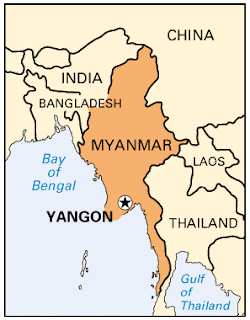
Unlike other politically isolated nations, there is a surprising about of freedom with regard to conversing with the locals of Myanmar (Burma), many of whom speak good English and are happy to talk about the problems facing the country. This makes Myanmar a fascinating place to visit. The traffic in Myanmar's former capital city of Yangon (Rangoon) has an interesting feature. There are no two-wheeled vehicles of any kind other than police vehicles, which is unique for a populous South-East Asian city.

Suppose 500 soldiers go into battle and 5 are fatally wounded. That's 5 fatalities, with a fatality rate of 1 fatality per 100 soldiers. The total number of soldiers is a measure of exposure: 500 soldiers are exposed to risk. If the battle is smaller, with only 200 soldiers, but at the same level of risk, we might expect only 2 fatalities. So reducing exposure reduces fatalities. If the battle is less intense, but of the same size, then 500 soldiers would again go into battle but the risk (as measured by the fatality rate) would be smaller; perhaps 1 fatality per 250 soldiers, and the number of fatalities again reduces to 2.

Road fatalities work in the same way. There are only two ways to reduce the number of fatalities: you reduce the risk or reduce the exposure to that risk, and most traffic policies affect both to some degree. Increased driver training seeks to reduce risk, but may also deter people from obtaining a licence which reduces exposure. Exposure is typically measured using either the total number of registered vehicles, the total distance traveled by all registered vehicles (which unfortunately is often inaccurate), or the total number of licence holders. If the risk remains constant, a large increase in these will lead to an increase in road fatalities.

Reducing the number of road fatalities to zero is easy: ban all motor vehicles. This reduces exposure to zero. Reducing exposure is easy to do, but while it may reduce fatalities, it inevitably impinges on the freedom of the individual. There is a trade-off, and so policies that reduce exposure are applied to circumstances where the risk is deemed to be high, such as with night-time curfews for young drivers and the setting of minimum driving ages. The policy in Yangon is an example of this approach. Even the safest motorcyclist acknowledges the increased risk that is present compared to driving a car. Yangon has reduced the exposure to zero for motorbikes which, relatively speaking, are a high-risk vehicle.

MUARC (Monash University Accident Research Centre) is perhaps the highest profile research group for road safety in Victoria. They have a publicly available series of reports. Some of these focus on cycling (here here here here) including a number on the use on bicycle helmets which I haven't included in the links. Other focus on motorcycling: on younger, older and high-risk riders (here here here), on crash information and countermeasures (here here here here), on training, licensing and hazard perception (here here here here).

Of particular interest is this report which reviewed motorcycle licensing and suggested an 'optimal model' for its implementation. The primary recommendation was that car licences should be a pre-requisite for bike licences (not implemented). Other recommendations included restrictions for L/P plate riders (zero alcohol, no pillion, power-to-weight) and an increase in the teaching of cognitive skills such as road-craft and hazard perception (all implemented to some degree). The reasoning behind these recommendations was clearly stated. Quoting from two sections of the report:

Another general principle of the optimal model is that, given the high crash risks associated with motorcycling, the model should not encourage increased exposure (...). For this reason, the total costs of obtaining a motorcycle licence (...) should not be cheaper than for a car licence.

The research suggests that any safety benefits of motorcycle licensing and training probably result more from exposure reduction (a reduction in the total amount of riding) than from crash risk reduction.


The aim of the proposed 'optimal model' is to contain exposure (i.e. to discourage the use of motorbikes) rather than to reduce risk. Surely then, it is the policy of Yangon that is the true optimum. But is it a bad one: should bikes be banned? Or perhaps we should ask the opposite question: should the use of bikes be encouraged, even if the increasing exposure leads to additional fatalities? What do you think?
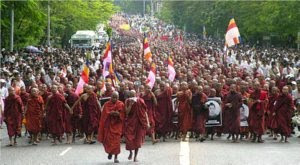
I think motorcycling should be made freely available to all those who desire it. The freedom of the individual to take his or her own risk is a right that should not be taken away by the state in the pursuit of lowering the road toll. In Melbourne, banning motorbikes would rightly lead to protests. In Yangon protests are met with force, and as demonstrated in 2007, dead protesters are soon forgotten. Yangon is not an example that should be followed.

Tuesday, April 27, 2010

The iPod Nano Bike Camera


I bought the new fifth generation iPod nano last month. My old Creative player and my current mobile phone are black-and-white displays; I don't update my gadgets very often. I was impressed. The main development of the fifth generation nano is the video camera. I had been looking for a bike video camera to video every second I'm on the motorbike while commuting and touring. The latest cameras from companies such as GoPro record in high definition. Technological advancement is focused on recording quality, while my focus is on battery life and storage capacity, and these often disappoint. The iPod nano was the solution.

I bought myself an iPod nano strap that joggers use for strapping their iPod to the upper arm. It also protects the iPod from the elements, as getting it wet is a bad idea. I attach it around the instrument cluster of the motorbike (top picture), and use some tape for additional waterproofing. It gives me sturdy mount that keeps the camera in place, and the iPod can easily be removed from the pocket on the strap. The strap can only be removed by disassembling the instrument cluster.

The video files are a little over 50 minutes for each 1GB. However the camera will automatically shut off when the file size reaches 2GB, at about 105 minutes. So at minimum you want 2GB of free space before starting the recording. The iPod comes in 8GB or 16GB versions; you can use either, but the 16GB is more suitable, as you don't have to keep deleting the 2GB video files before recording the next one. The 80 albums on my 16GB iPod take up about 6.4GB of space, so I have space remaining for 4 2GB video files before I need to start deleting older files. You can't delete parts of a file, so if you catch something that you want to keep, you'll have to keep the entire 2GB file until you reach a computer to upload it.

Battery life for video recording runs at slightly under two hours. If you record from a full charge, the camera will shut off at about 105 minutes, by which time your battery will be nearly empty. The good news is that the iPod can be recharged while it's recording. There are many battery extender solutions, both those made for the iPod and those made for any device with a USB cable. Some use AA or AAA batteries and others are charged by USB. I use a Duracell recharger which is charged by USB and has an on/off switch. I zip-tie the charger to the frame down-tube, with the iPod recharging cable connecting the iPod to the charger. When I start the video I also turn on the charger, which keeps the iPod fully charged as the charging rate is above what is needed for use. No more battery problems, and the iPod is ready for me to listen to some top-notch late nineties brit-pop once I reach my motel.

Using the iPod nano as a bike video camera is a surprising good solution. Video quality is 640x480 pixels at 30fps, which is good enough for my purposes (example six second video below, reduced to 320x240). The problem with portable video cameras for touring is always battery life, but the wide availability of battery extender solutions and the fact that you can recharge while recording means that you can get around this problem for the iPod. There are some disadvantages though. The auto 2GB shut off means stopping every 105 minutes to re-start the camera. Extensive use may lead to reduced battery performance over time. And you are taking the risk that the iPod will get wet and be ruined; while the jogging strap offers some protection, it is not waterproof. But overall, it works very well. It's worth a try if you already own one.